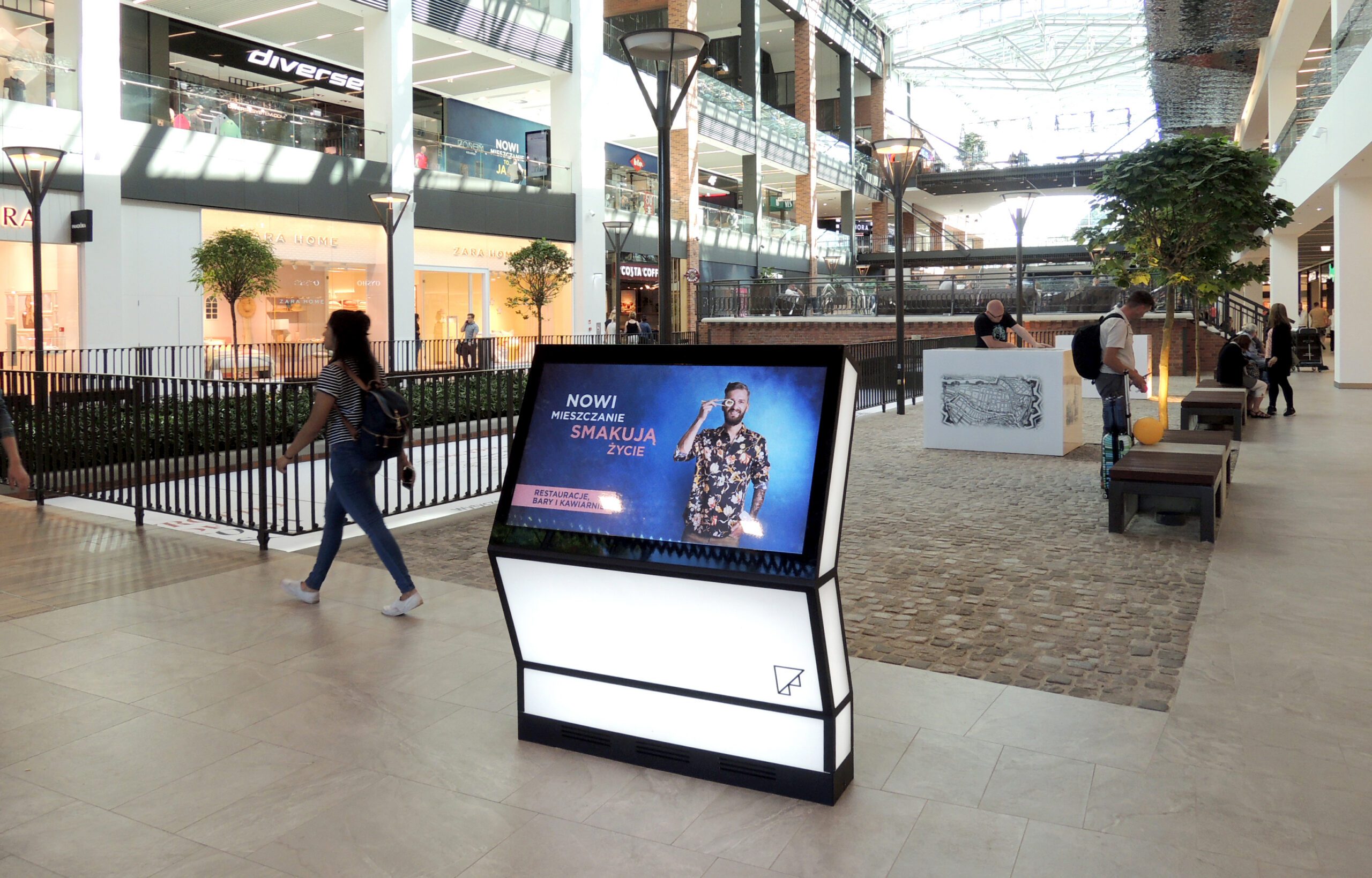

How can digital signage enhance wayfinding?
Digital signage is increasingly present in the environments Air Design works in including mixed-use, retail, leisure, hospitality, residential, towns & cities, and campus environments . Used well, it can meaningfully improve how people navigate a space. Used poorly, it adds visual clutter without solving any of the underlying navigation problem.
What digital signage can do that static signage cannot
The fundamental advantage of digital signage in a wayfinding context is adaptability. A static sign carries information almost indefinitely. A digital screen can carry different information at different times, for different audiences, in different languages, responding to real conditions in the space.
In practical terms this means:
- Real-time updates — temporary closures, event-specific routing, emergency information, and changing tenant configurations can all be reflected immediately without reprinting or replacing physical signs.
- Personalisation — interactive directories and wayfinding kiosks allow visitors to search for a specific destination and receive a tailored route, rather than interpreting a static map of the whole environment.
- Multilingual delivery — in environments with diverse visitor demographics, digital screens can present information in multiple languages either simultaneously or on demand, supporting inclusive navigation without cluttering physical signage with multiple scripts.
- Time-sensitive content — in a retail or leisure destination, digital wayfinding can surface different information at different times of day, morning delivery routes for staff, evening leisure options for visitors, event directions during peak periods.
Where digital signage works best
Digital signage earns its place in a wayfinding system where the environment is genuinely complex, the visitor demographic is diverse, or conditions change frequently. The strongest use cases are:
- Airports and transport hubs — departure gates, platform changes, and real-time service information are all dynamic by nature. Digital wayfinding is not a preference here, it is a necessity.
- Large-scale retail and mixed-use destinations — environments with high footfall, frequent events, and changing tenant configurations benefit significantly from dynamic directories and interactive mapping.
- Hospitals and healthcare campuses — where patients are often anxious, unfamiliar, and navigating under time pressure, digital directories at entrance points and key decision junctions can reduce the cognitive load of finding a destination.
- Corporate campuses and workplace environments — meeting room availability, visitor registration, and internal navigation all benefit from integrated digital systems.
The limits of digital signage in wayfinding
Digital signage is a powerful tool, but it does not replace the need for a coherent wayfinding strategy or permanent physical signage. The most common mistake is treating digital screens as a solution to a navigation problem that is caused by poor spatial planning, unclear hierarchy, or inconsistent identity.
A screen cannot compensate for a building layout that is fundamentally confusing. It cannot replace the reassurance of a well-positioned physical sign at a decision point, and it introduces dependencies power, connectivity, content management, and maintenance that static signage does not.
Air Design’s approach is to treat digital and physical signage as complementary rather than an either-or option. Physical signage provides the consistent, reliable backbone of a wayfinding system and acts as an extension of a brand. Digital elements are layered in where they genuinely add value such as at entrances, major decision points, and high traffic areas, rather than being deployed throughout as a default.
Integrating digital signage into a wayfinding system
Successful integration of digital signage into a wayfinding scheme requires the same strategic thinking as any other design element. The questions we ask:
- Where do people most need dynamic or personalised information?
- How will content be managed, by whom, and how frequently?
- How does the digital element relate visually to the physical signage system
- Does it feel like part of the same scheme or a separate overlay?
- What happens when the screen is off, loading, or displaying an error?
That last question matters more than it might seem. A blank or broken screen at a critical decision point is worse than no screen at all. Robust content management and a clear fallback position are essential parts of the design brief, not afterthoughts.
Air Design’s approach to digital wayfinding
Air Design has integrated digital wayfinding components into schemes across retail, hospitality, and mixed-use environments. Our starting point is always the user experience, understanding how people move through a space, where they get lost, and what information they need at each point in their journey.
From that foundation, digital signage is specified where it genuinely solves a problem rather than where it creates an impression of modernity. The result is wayfinding systems that work consistently across both physical and digital touchpoints, with a coherent visual identity that holds across every element of the scheme.
If you are scoping a wayfinding project that includes a digital signage component, get in touch to discuss your brief with our team.